Regulatory-grade is not a differentiator… it’s a confession
Don't outsource your value-prop to regulators
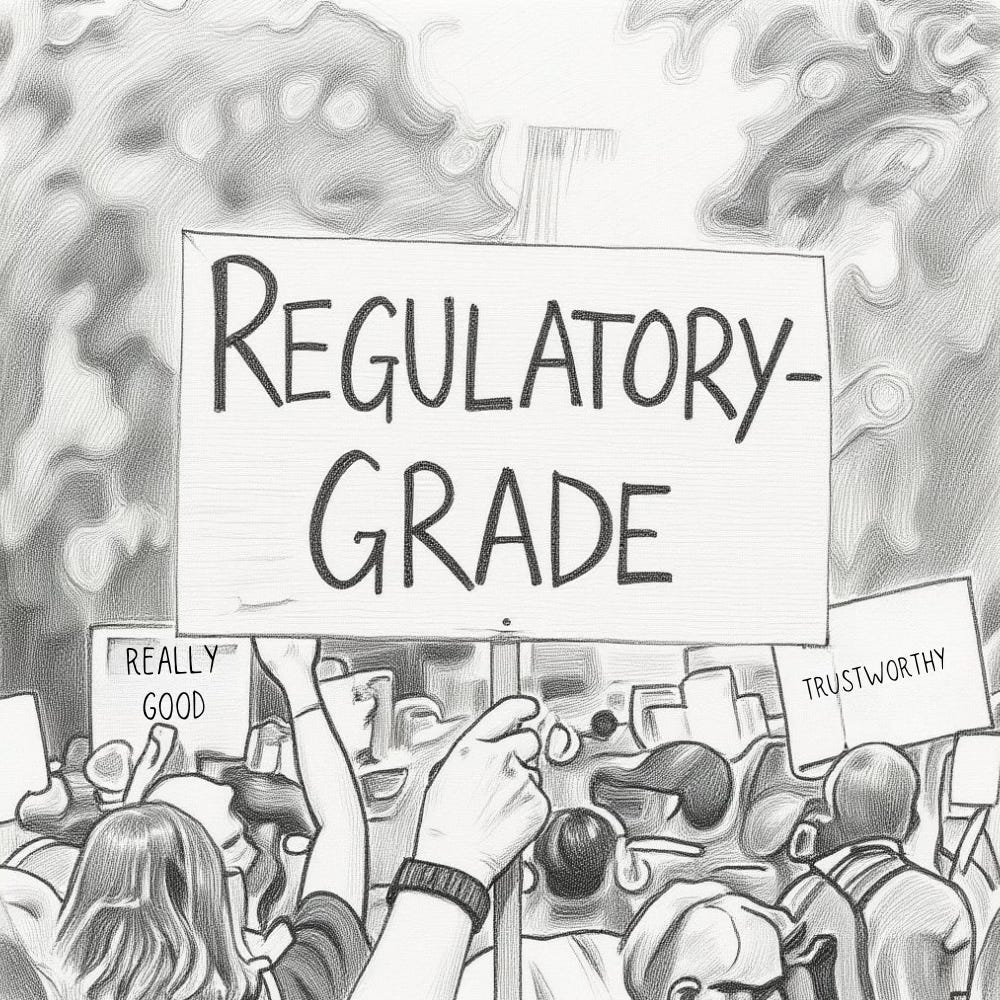
Compliance matters, but leading with it is a strange thing to do.
Yet I open LinkedIn any day of the week, and I’m inundated by it. AI platforms described as “regulatory-grade.” Data products built to “regulatory-grade standards.” Clinical decision tools reassuringly positioned as “regulatory-grade.” One health data company promises “regulatory-grade insights from real world patient data.” Another announces it is “setting the benchmark for regulatory-grade AI lifecycle assurance in healthcare.” A third offers to help organisations “generate regulatory-grade data.”
What it actually sounds like is a restaurant putting “we wash our hands” on the menu. Basic, expected, and not the thing.
If you operate in a regulated environment, meeting compliance requirements is not a feature, it’s the condition for being in the market at all; it’s your table stakes. Saying your product meets regulatory standards is like saying your payments platform processes payments correctly, or your CRM system stores customer records. You are describing the floor, and calling it the ceiling.
So when compliance becomes your headline, are you not actually telling potential customers something you probably did not intend: that you haven’t got anything more interesting to say?
Healthcare makes this especially visible, and especially strange.
There are many regulated AI and machine learning-enabled medical devices on the market; it’s not a small club. When thousands of products have cleared that same regulatory pathway, “regulatory-grade” carries about as much signal as “internet-enabled.” It tells you nothing about whether the product is good.
I understand why companies reach for the simple language. Regulated sectors are nervous about AI. Buyers are cautious; the procurement cycles are long, and “compliant” feels like a credible signal in a room full of people who are worried about getting it wrong. There is also genuine complexity here: documentation burdens, audit trails, validation studies, risk assessments that should be updated as models change. Getting this wrong has real consequences for organisations and, in healthcare specifically, for patients. Still, framing that as a differentiator misrepresents the fact that it’s a baseline.
And there’s a bigger problem.
Regulatory compliance is designed to manage known, categorised risks. Regulations were written by people who had to anticipate harm before it happened. AI doesn’t fit well with that process. The regulatory apparatus now has to adapt frameworks designed for static systems to accommodate dynamic, continuously learning systems that evolve after deployment.
The regulatory frameworks are catching up, but they are not there yet.
You can meet every applicable regulatory standard and still deploy a model that performs well on the validation dataset but drifts badly in actual use. You can pass every audit and still have a risk tool that underperforms on groups that were underrepresented in your training data. You can be fully documented and still be wrong.
Regulatory compliance manages the risks regulators have already named; but it doesn’t manage the ones they have not.
And yet, there’s a more interesting story that most companies are not telling.
Compliance in any vertical is time and cost intensive, and this is where AI is starting to do something genuinely valuable; not just being subject to compliance requirements, but automating the infrastructure around them: continuous monitoring for model drift; automated gap analysis against evolving regulatory frameworks; audit trails generated from structured data.
These are real capabilities, and arguably differentiating ones.
So what should you say instead? Be specific about what your product actually does. What decisions does it improve and what value does that drive? If you are using AI to make compliance faster, cheaper, or more reliable, explain exactly how. Those are claims with edges. They can be tested and they mean something.
I’m sorry but to me, “Regulatory-grade” sounds just like non-specific, hand-waving noise.
It belongs in your documentation, but if it is the strongest thing you can say in your headline, you don’t just have a positioning problem, you have a product problem.
Katie Lips is CEO and Founder of Rebel Futures. She helps organisations grasp the opportunities at technology inflection points, from the early web and pre-iPhone mobile to cloud-based SaaS and now AI. She has held senior roles at EY and Aimia, and was Head of Digital Policy at Which?. Katie holds a Harvard Kennedy School qualification in Leading in Artificial Intelligence and is a Founder Institute graduate.
Related: explore our work on AI Strategy.

